
The story
Tourism Under Pressure · Laos · Verified 20 September 2026
Laos has not introduced a new entry rule or a blanket ban on low-priced tours. At a national meeting on 18 September, tourism and agriculture-environment authorities agreed to coordinate inspections of tourism businesses, act against so-called zero-dollar tours and address suspected wildlife-linked sales. The practical consequence for a visitor is a stronger reason to check who operates a package, what its price includes and whether shopping stops are optional—not a reason to assume every bargain is unlawful.
That distinction matters because the official notice sets an enforcement direction rather than publishing a traveler-facing definition, a list of offending companies or evidence that the practice is typical. It also does not say ordinary visas, border procedures or independent itineraries have changed.
The notice joins two oversight problems
The Lao Department of Forestry says the meeting brought the Ministry of Culture and Tourism together with the Ministry of Agriculture and Environment. Their stated concerns include tourism businesses operating outside the rules, tours whose economics depend on opaque spending, and channels through which wildlife products may be sold. The agreed response includes coordinated inspections and possible action affecting business licences.
This is more than a wildlife-only announcement. It treats consumer protection, operator compliance and conservation as linked parts of the visitor economy. Laos has also been reporting strong tourism growth: an official government account put arrivals above 2.1 million in the first five months of 2026, while the Tourism Marketing Department reported nearly 2.6 million in the first half. Those figures cover different periods and should not be combined, but both explain why service standards and where tourism money flows have become policy questions.
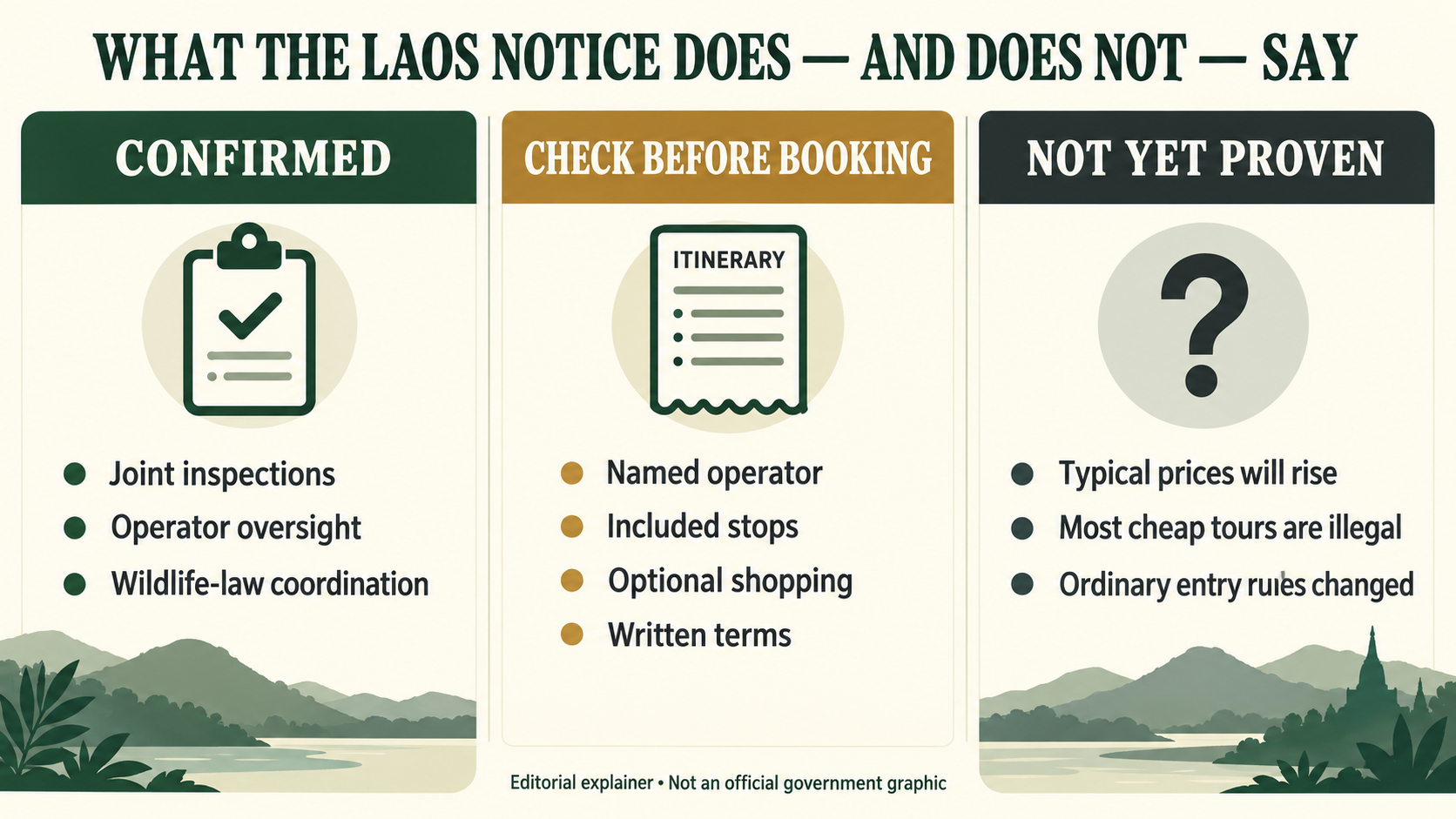
AI-generated editorial explainer based on the 18 September notice; it is not an official government graphic.
A low price is a prompt to ask questions, not proof
The official notice uses the term “zero-dollar tours,” but the reviewed material does not give foreign visitors a test that turns a particular price into a legal finding. A cheap package can be a genuine promotion, a limited-inclusion product or a loss leader. The concern is an opaque arrangement in which the advertised price hides compulsory purchases, controlled shopping stops or revenue channels that are not clear when the traveler pays.
Before booking, ask for the legal name of the operator, a written itinerary, the included transport and admissions, the cancellation terms and a clear answer on whether shopping stops are optional. Keep the listing and receipt. If a guide changes the itinerary or pressures the group to buy, record what was promised and ask the booking platform or operator for an explanation. These checks cannot certify that a business complies with Lao law, but they can expose a mismatch before it becomes a costly argument.
Wildlife products require a separate caution. The September notice links tourism establishments with suspected wildlife-trade channels, but it does not prove that most shops or tours are involved. Do not treat an unlabeled food, medicine or souvenir as legal because it is openly displayed. Ask what the material is, request documentation where relevant and avoid a purchase when the species or legal status is unclear. The safest editorial conclusion is narrower than a list of supposedly prohibited items: uncertainty is a reason not to buy, not a licence to identify contraband by appearance.
What may change—and what remains unknown
More inspections could benefit visitors and compliant local businesses if packages become easier to compare and fewer itineraries depend on surprise spending. They could also raise compliance costs, and package prices might change if hidden cross-subsidies disappear. The official material does not yet establish either outcome. It names no inspection calendar, province-by-province rollout, suspended operator or measured effect on prices.
That leaves a useful boundary for trip planning. There is no basis in the reviewed notice to cancel an ordinary Laos journey or treat independent travel as restricted. There is a basis to prefer a named, accountable operator and terms that make stops and payments visible before departure. The enforcement push will become more meaningful to travelers only when authorities publish results, clearer definitions or practical reporting guidance.
The broader question is where tourism revenue lands. A transparent package may cost more upfront yet direct more spending to licensed guides, accommodation, restaurants and local services. But official enforcement alone does not prove that outcome. Travelers can support it by choosing clarity over a headline price whose real conditions appear only after the tour begins.
Sources and evidence status
> Independent editorial coverage. No affiliate links, paid placement or commercial partnership.
>
> This is not immigration or legal advice: use official Lao tourism, environment and customs guidance for the product and journey in question.