
The story
Tourism Under Pressure · Hong Kong · Verified 20 September 2026
Hong Kong's trial booking system for the Po Pin Chau section of the High Island Geo Trail is narrow but easy to misread. On the remaining designated dates—20 and 25–27 September, and 1–7 October 2026—entry between 09:00 and 17:00 requires a free, real-name reservation. The rule does not close the whole East Dam, and it does not apply to Po Pin Chau outside those dates or hours.
That boundary is the useful answer for a visitor. If Po Pin Chau is the purpose of the trip, book the correct two-hour entry window and carry the document used in the booking. If the slot is unavailable, the East Dam and Biu Tsim Kok sections of the geo trail remain outside this reservation system. A different date or entry before 09:00 or after 17:00 also falls outside the pilot, although weather and trail safety still matter.
Match the date before opening the booking page
The Agriculture, Fisheries and Conservation Department lists the remaining reservation dates as 20 September, 25–27 September and 1–7 October. October bookings open on 21 September at 11:00 Hong Kong time. Each day has four entry sessions—09:00–11:00, 11:00–13:00, 13:00–15:00 and 15:00–17:00—with 500 places per session and 2,000 per day, allocated first come, first served.
The reservation is free and handled through Klook. One registrant can reserve for up to five people, but every visitor, including children, needs a place. AFCD says each visitor's name and identification details must match the identity document presented if staff request it. Its FAQ explicitly accepts a Hong Kong identity card, travel document, Mainland Travel Permit for Hong Kong and Macao, or Chinese resident identity card; for an overseas visitor, a passport is the practical travel document to use.
Source scope: AFCD's live booking guide, checked 20 September 2026. A booking controls entry to one trail section; it is not a transport reservation or a guarantee of safe weather.
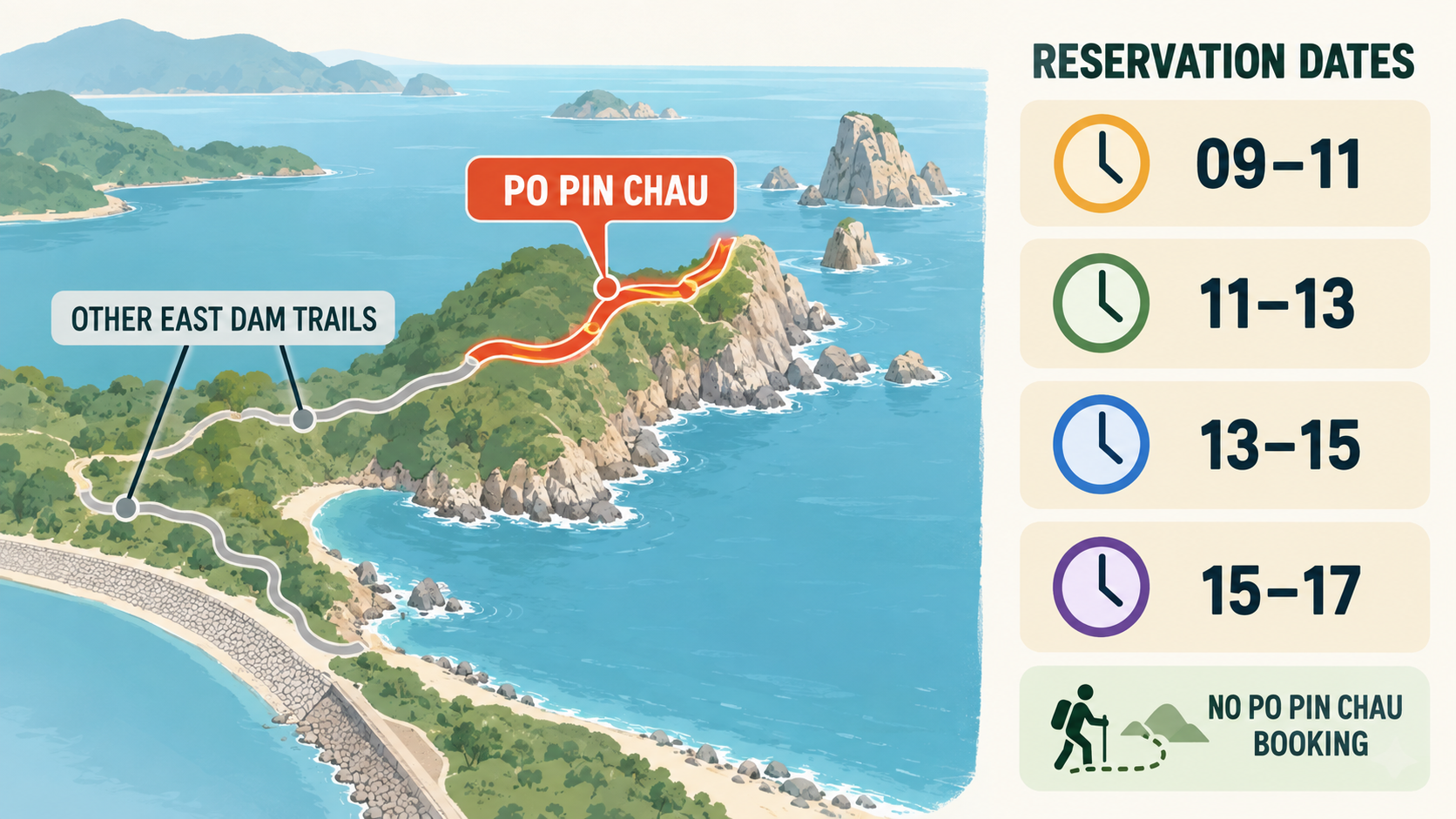
AI-generated schematic, not an official map. The highlighted route is conceptual; use AFCD's trail information for navigation.
A two-hour slot is an entry window, not a stay limit
The booked session is the period in which you should enter. AFCD says there is no fixed time by which a visitor must leave after admission. Arriving early does not guarantee early entry: staff may allow it only if the current session has spare capacity. If you miss the booked window, staff may try to place you in a later session, but a full quota can mean a long wait.
Walk-in entry is equally conditional. A visitor without an advance booking may make an on-site e-booking only when that session still has places. Treat that as a fallback, not a plan. Cancellations are allowed until 48 hours before the session, so returning an unused place is the simplest way to reduce no-shows without turning a free public-access pilot into a paid product.
The physical trip deserves as much attention as the booking. AFCD describes the return route as about two kilometres with roughly 200 metres of ascent, around two hours of walking and a three-out-of-five difficulty rating. It has rough ground, no shade, supply point or mid-route exit. The entrance is beside the route 9A minibus terminus at High Island Reservoir East Dam; AFCD advises allowing time for the queue and checking live transport information.
Weather can cancel the reservation
The booking is not permission to ignore a warning. AFCD says later sessions are automatically cancelled under a black rainstorm warning or typhoon signal No. 8 or above. Signal No. 3, yellow or red rain warnings, thunderstorms affecting the eastern New Territories, and nearby lightning can also cancel or delay entry under the published rules. Route 9A suspends during a black rainstorm warning or signal No. 3 and above until conditions permit recovery.
This is why the best itinerary has two decisions, not one: secure the correct Po Pin Chau entry session, then make a fresh weather and transport decision on the day. Visitors who value certainty more than the specific viewpoint can use the unreserved East Dam or Biu Tsim Kok sections instead. The trade-off is less access to the named trail, but more flexibility if quotas, transport or weather do not align.
The pilot may help spread visitors and protect a sensitive path, but its existence does not prove that crowding or ecological wear has already fallen. It is a trial for one section, on named dates and hours. That limited scope is also what keeps the practical advice simple: check the date, reserve the real-name entry window when required, carry matching identification, and keep a weather-safe alternative.
Sources and evidence status
> Independent editorial coverage. No affiliate links, paid placement or commercial partnership.
>
> This is not immigration or legal advice: use current AFCD, Hong Kong Observatory and transport guidance for the planned date; this article is not safety advice.