The story
The Korea Forest Service and VISITKOREA/Weatheri differ by five to seven days for Seoraksan, Naejangsan and Hallasan. That is a reason to build flexibility into an autumn trip, not proof that one forecast is wrong.
Last verified: 22 September 2026 · Destinations · Korea, Republic of
The useful answer for a 2026 South Korea autumn trip is to treat the forecasts as planning ranges rather than guaranteed appointments. A Korea Forest Service release dated 22 September places peak foliage at Seoraksan on 20 October, Naejangsan on 4 November and Hallasan on 6 November. A Korea Tourism Organization page published on 8 September, crediting Weatheri, gives 25 October, 11 November and 13 November for the same mountains.
Those gaps are five days at Seoraksan and seven days at both Naejangsan and Hallasan. The dates can shape an itinerary, but the accessible source pages do not establish that the two forecasts use identical observation points, species or peak definitions. Comparing the numbers is valid; declaring a winner is not.
What the two forecasts actually say
The Forest Service's government release describes a national peak as the point when foliage reaches 50% and says its work draws on long-term seasonal observation, mountain-weather data and cooperation with public arboretums. Its named mountain dates include 20 October for Seoraksan, 28 October for Songnisan, 4 November for Naejangsan and 6 November for Hallasan.
VISITKOREA's forecast separates first foliage from peak foliage. It lists first foliage at Seoraksan from 3 October and at Hallasan from 31 October, while the peak dates are later. It also warns that actual timing can change with the weather. That distinction matters: the first visible colour is not the same planning target as a predicted peak.
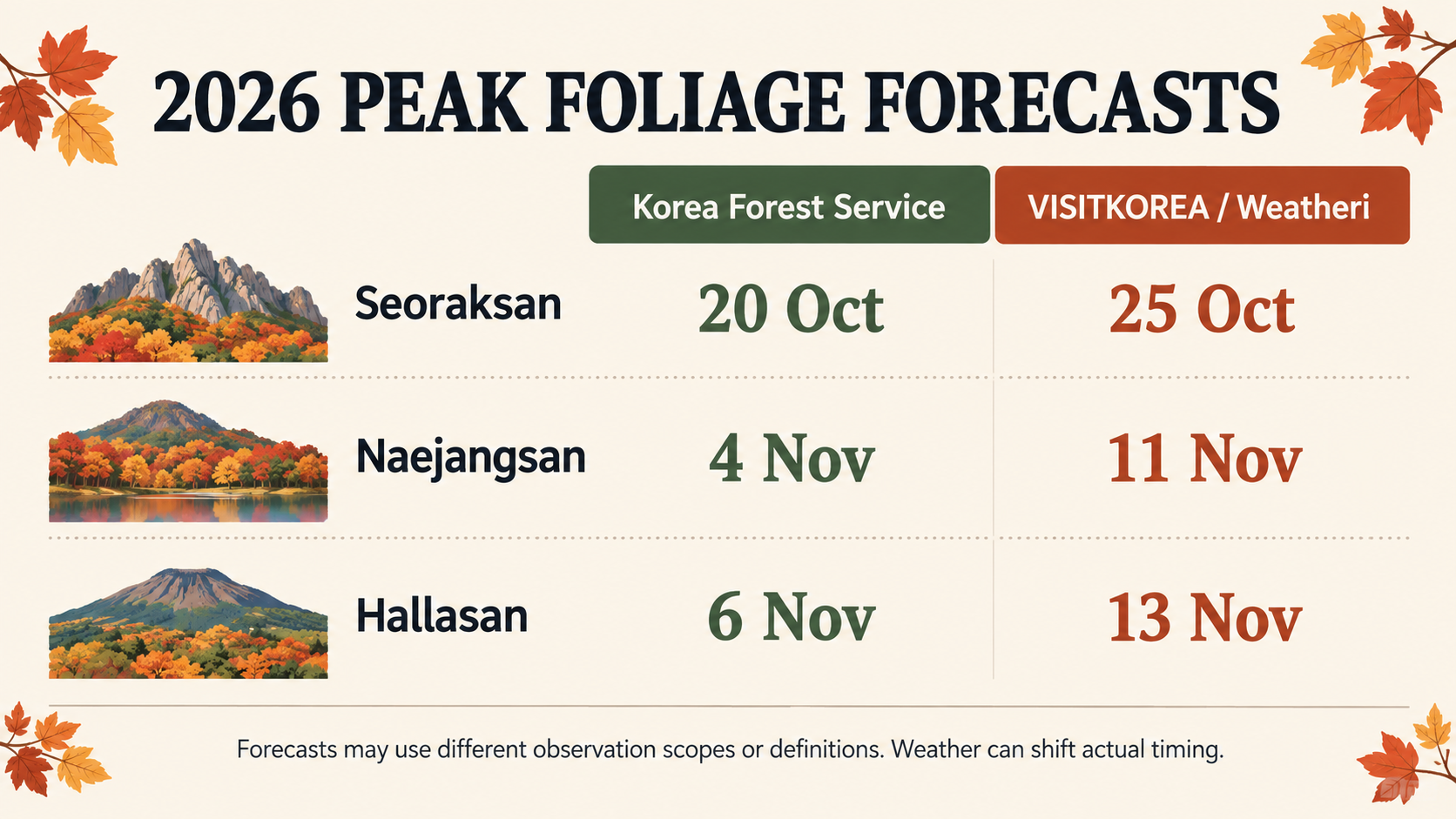
These are source-specific forecasts, not observed conditions. The public pages do not show that their observation scope or peak definitions are identical, and weather can shift the result.
Which week should a traveler choose?
For Seoraksan, the combined range is 20–25 October. For Naejangsan, it is 4–11 November. For Hallasan, it is 6–13 November. Those windows are an editorial planning aid derived from the two published dates, not a third official forecast.
A traveler with fixed flights should choose the destination whose range fits the trip, then accept that colour may be earlier, later or uneven across elevation and species. Someone deciding between regions can use the north-to-south progression: Seoraksan's range comes first, followed by the two southern destinations in November. The sources do not support promising perfect colour on every trail or viewpoint within those periods.
The same caution applies to city foliage. VISITKOREA lists Bukhansan, near Seoul, with a 4 November peak forecast, but a mountain date does not guarantee that every Seoul park or street will look the same that day. Travelers seeking easier walks or a trip with older companions should choose access and terrain first, then use the forecast as a timing signal.
Build flexibility without over-planning
1. Anchor the trip to a range. Keep two or more days within the relevant mountain's combined window where possible.
2. Separate colour from access. These forecasts do not confirm trail openings, reservations, transport frequency or daily weather. Check the relevant park or local operator before travel.
3. Avoid non-refundable decisions based on one date. A forecast can guide a hotel region or sequence, but it cannot guarantee a view.
4. Check live conditions close to departure. Look for current official park notices and recent on-site updates rather than treating a September forecast as an observation.
5. Keep a lower-effort alternative. If weather or access makes a mountain unsuitable, a city park or cultural stop can preserve the day without chasing colour across the country.
The disagreement is not a defect travelers need to solve. It is a reminder that seasonal travel sits between long-range prediction and conditions on the ground. Choose the right part of Korea for the right week, but leave the final day flexible.
Sources and evidence status
> Independent editorial coverage. No affiliate links, paid placement or commercial partnership.
>
> This is not immigration or legal advice: use official South Korean guidance for current destination access, weather and safety conditions.